

The MOTS-c Hangover Effect
How this amazing mitochondrial peptide works, why it eventually stops feeling amazing, and the biochemical fix hiding in plain sight.


MOTS-c, which stands for Mitochondrial Open Reading Frame of the 12S rRNA Type-C, is one of the most compelling peptides in performance medicine right now. It drives fat burning, improves how your body handles blood sugar, supports mitochondrial function, and does something almost no other compound can claim: it is encoded in your own mitochondrial DNA, meaning your body actually produces it naturally as part of normal cellular function. People commonly use it for improving body composition, metabolic health, and cellular longevity.
Most people feel the promised effects within the first week or two. You have more energy, you are losing fat, and workouts that had you exhausted for the rest of the day start feeling manageable again. Then somewhere around week two or three, something changes. Brain fog sets in. Your mood goes flat. You are working just as hard in the gym but your body is not recovering the way it was. A lot of people stop at that point assuming the peptide just did not work for them.
But it did work, and what they ran into is a predictable consequence of exactly how MOTS-c works at the cellular level. However, once you understand the mechanism, the fix becomes pretty obvious.
How a Single Blocked Enzyme Tells Your Body to Burn Fat
MOTS-c works by blocking ATIC, a key regulatory enzyme in the folate cycle that controls how your cells distribute and use folate across dozens of biological processes. When ATIC gets blocked, a compound called AICAR accumulates inside your cells. AICAR is a naturally occurring metabolite that your body normally produces in small amounts, but when it builds up in larger quantities it sends a very specific signal to the cell: energy supplies are critically low, the same internal state your body enters during prolonged fasting or intense exercise. That signal activates AMPK, a fuel-sensing enzyme that sits at the center of your cells’ energy management system. When AMPK turns on, your body stops prioritizing fat storage and starts burning what it already has, and your cells become significantly more responsive to insulin, clearing blood sugar from the bloodstream more efficiently. Blocking ATIC is not a side effect of MOTS-c. It is the entire mechanism, and the peptide works precisely because it creates that accumulation.
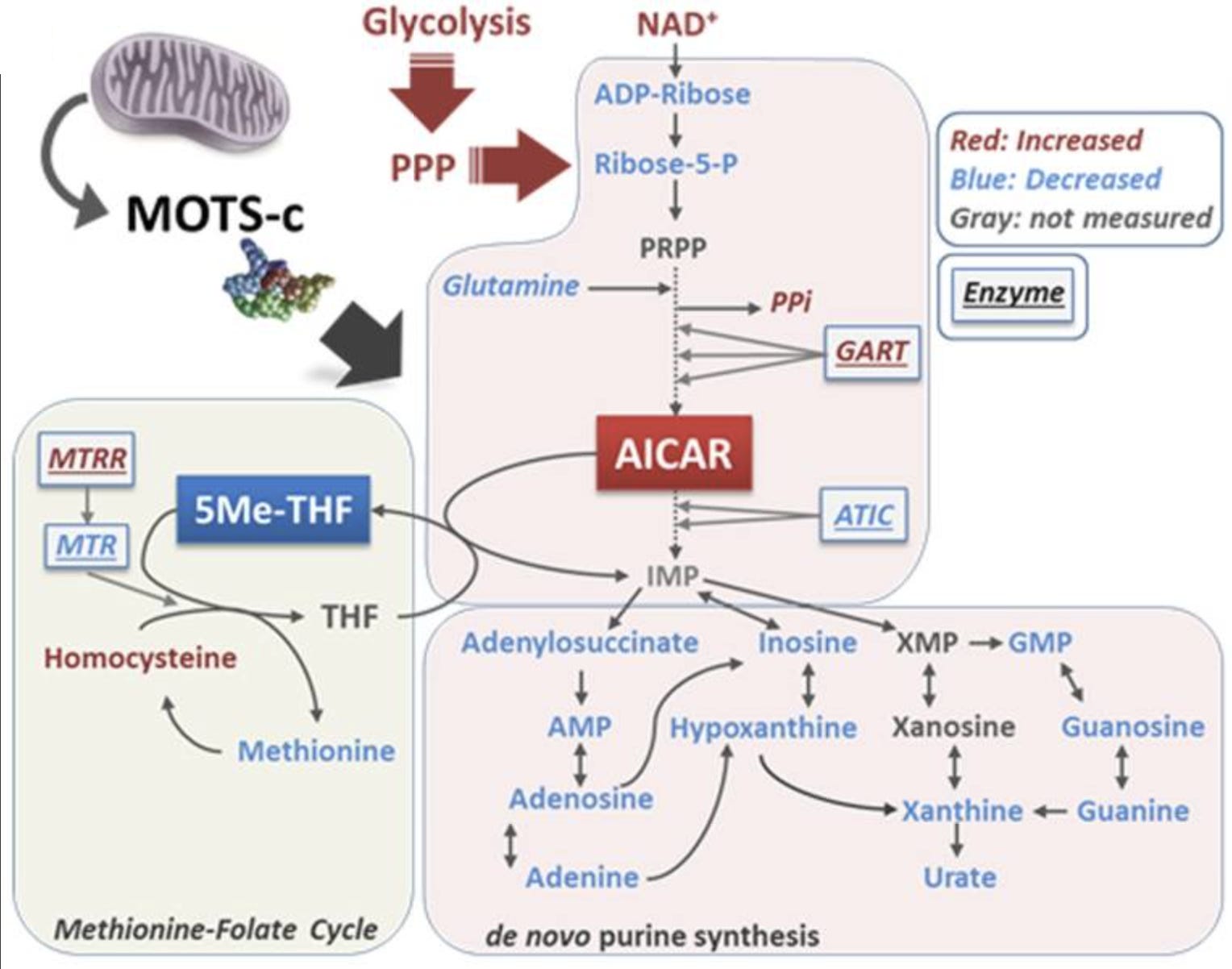
The fat burning response also scales with how much AICAR accumulates, which is why higher doses produce a stronger metabolic signal in people running active body composition protocols. The starting point I recommend is 1 mg on workout days, which gives you the AMPK activation without stressing a system you have not yet had a chance to assess. People running higher doses are doing so with a specific goal in mind and a clear picture of how their body responds, and that is a conversation that belongs in a one on one context rather than a blanket recommendation.
This Is Where the Fog, the Flat Mood, and the Stalled Recovery Come From
The same mechanism that makes MOTS-c work is also what creates the wall people run into at week two or three, and it comes down to what happens across the rest of the folate cycle when ATIC gets blocked.
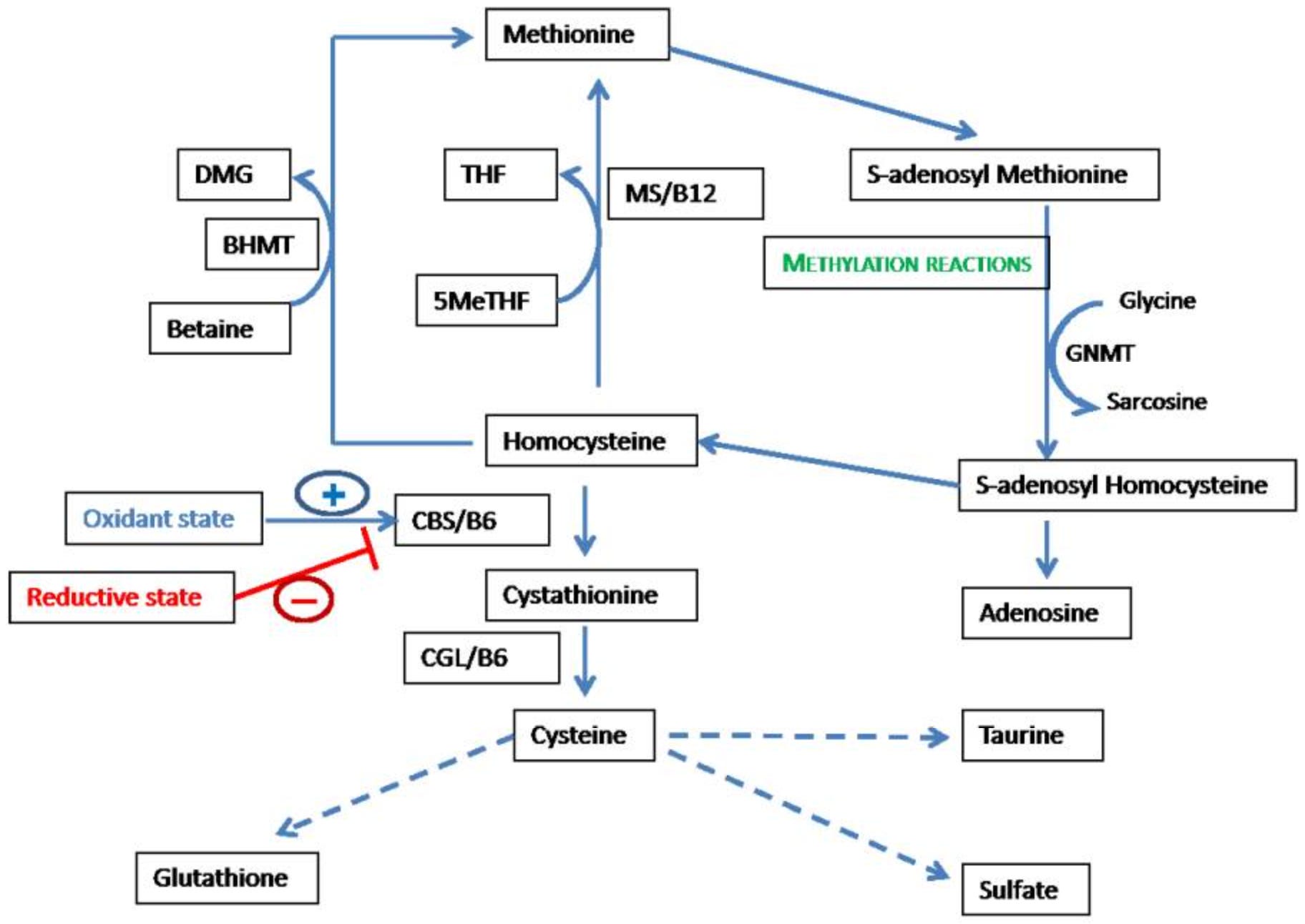
Your folate cycle has one job beyond everything else it does: recycling a compound called homocysteine back into methionine. Homocysteine is a byproduct that your body produces constantly as part of normal cellular function. Every time your cells use a methyl group, which happens hundreds of times per second across your tissues, methionine gets converted into homocysteine as the leftover product. The folate cycle normally clears that homocysteine quickly by donating a methyl group back to it, converting it back into methionine and keeping levels in check. When MOTS-c blocks ATIC, folate intermediates back up across the entire cycle, that recycling process slows down, and homocysteine starts to accumulate in your blood and tissues.
Elevated homocysteine is directly inflammatory to blood vessels and neurological tissue, and it disrupts the production pathway for dopamine and serotonin, which both depend on the same folate-driven process to get made. It also slows nucleotide synthesis, which is how your muscles repair the micro-tears that accumulate during training. Connect those three things to what people actually report and the picture becomes clear: the brain fog is the neuroinflammation and the drop in neurotransmitter production, the flat mood is the disrupted dopamine and serotonin, and the recovery that stopped keeping pace with training is the muscles not getting the raw materials they need to rebuild. None of it is mysterious once you trace it back to the folate cycle.
Why Methylfolate Is the Wrong Answer
The first thing most people reach for when they hear “folate cycle disruption” is methylfolate, the active form of folate that bypasses the MTHFR conversion step that a significant portion of the population handles poorly. The logic sounds right: if the folate cycle is backed up, give the body the most bioavailable form of folate available and let it sort itself out.
The problem is that methylfolate feeds directly into the same congested pool that MOTS-c already disrupted. MOTS-c is not blocking MTHFR, the enzyme methylfolate bypasses. It is blocking ATIC, which sits upstream of where methylfolate enters the cycle. The folate intermediates are already backed up at that point, and adding methylfolate into a system that cannot move what it already has does not clear the backup. You are increasing supply into a pipeline that is already at capacity, and the homocysteine keeps accumulating regardless of how much methylfolate you add.
Why Leucovorin Works Where Methylfolate Fails
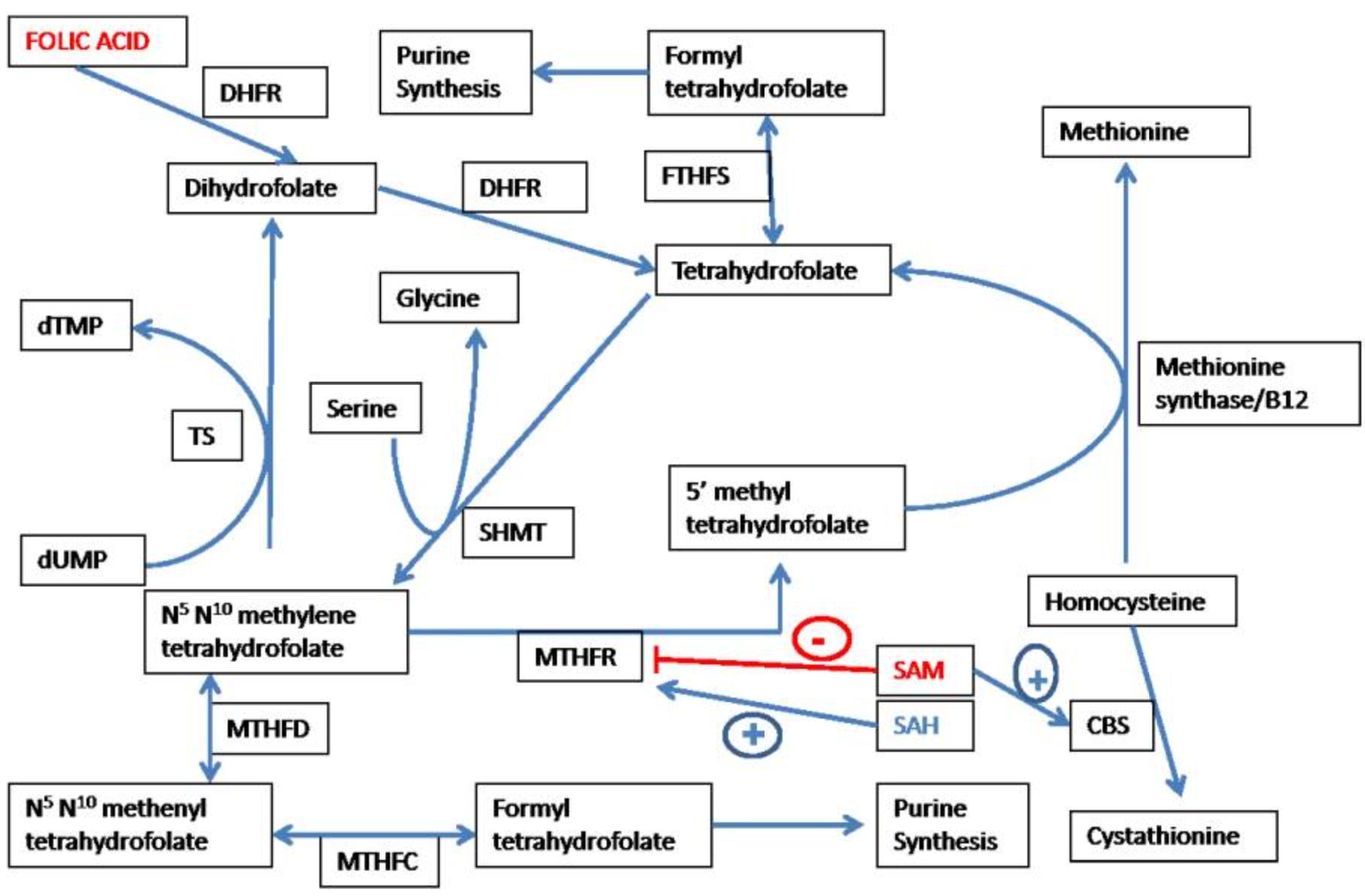
Leucovorin, the reduced folate form known as 5-formyl-THF, solves this by entering the folate cycle at a completely different point, downstream of where MOTS-c created the blockade. It does not compete with the congested step. It routes around it entirely, restoring the folate the body needs for homocysteine recycling, neurotransmitter production, and tissue repair without touching the AMPK signal MOTS-c already triggered. The fat burning keeps running and the folate debt gets paid at the same time.
Clearing homocysteine through that restored folate pathway also requires methylcobalamin, the active form of B12. Here is why you cannot solve the methyl group problem with more folate alone: methylfolate does carry a methyl group, but it cannot donate it directly to homocysteine. It has to hand that methyl group off to B12 first, and B12 carries it the rest of the way to homocysteine, converting it back into methionine. The enzyme running that reaction requires B12 as the intermediate carrier, and without it the methyl group gets trapped on the folate molecule with nowhere to go. That phenomenon, where folate gets locked in its methylated form and pulled out of circulation for everything else the cycle needs to do, is called the methyl trap. Adding more methylfolate in that state makes the problem worse, not better, which is why methylcobalamin is not optional in this stack.
How to Actually Run This Stack
The most straightforward way to avoid the homocysteine buildup and the symptoms that come with it is to not run MOTS-c every day. Taking days off gives the folate cycle time to clear the backup on its own, and for people doing lighter protocols that is often enough. The issue is that most people running MOTS-c for body composition are training consistently and want the metabolic signal on their hardest days, which is exactly when the folate debt accumulates fastest.
The solution is to pair MOTS-c with Leucovorin and methylcobalamin from the start rather than waiting until the symptoms show up. Based on the mechanistic picture and what I would recommend for anyone running this peptide consistently, the protocol looks like this.
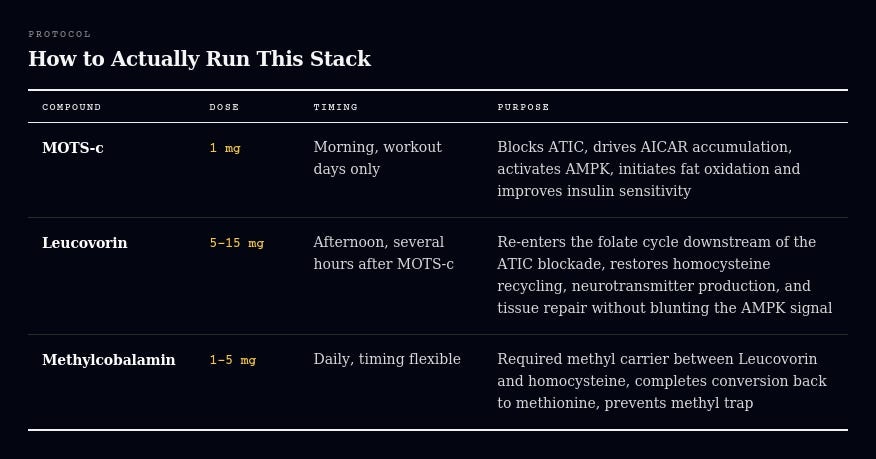
MOTS-c at 1 mg subcutaneous on workout days is the entry point. Stay there until you have a clear sense of how your body responds before considering anything higher. People running more aggressive body composition goals tend to move the dose up over time, but that is individual and not something I put a universal number on.
Leucovorin comes in the afternoon between 5 mg and 15 mg. The morning MOTS-c dose needs time to run its course and let AICAR accumulate before you start restoring the folate pool, so the afternoon window is deliberate and not interchangeable with the morning.
Methylcobalamin at 1 mg to 5 mg daily completes the stack. It does not need to be timed around the other two. Your body needs it available consistently to keep the homocysteine conversion running, and a single daily dose covers that.
What to Track and What the Numbers Mean
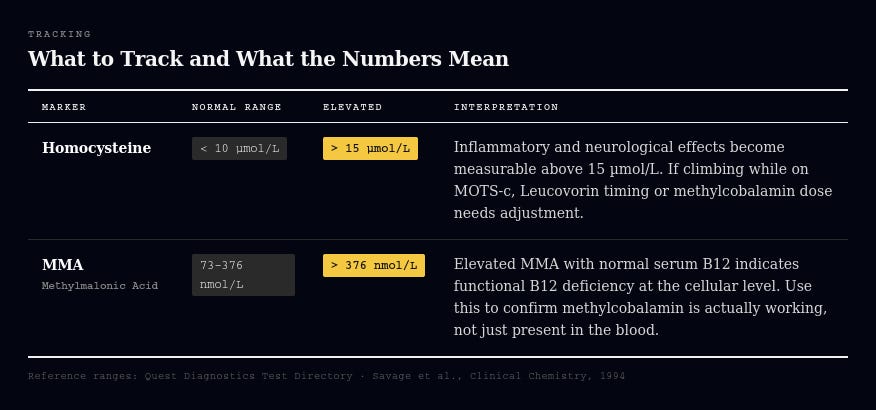
If you want to confirm the stack is working as intended, two blood markers tell you everything you need to know.
Homocysteine is the primary one. A normal homocysteine level sits below 10 micromol/L, and elevated levels above 14-15 micromol/L are where you start seeing the inflammatory and neurological effects described earlier. If you are running MOTS-c consistently and homocysteine is climbing, your Leucovorin timing or your methylcobalamin dose needs adjustment. If it is holding flat or trending down, the stack is doing its job.
MMA, or methylmalonic acid, is the secondary check. Serum B12 levels can look normal on a standard blood panel even when your body is not actually using B12 efficiently at the cellular level. MMA is a more sensitive marker of functional B12 activity than serum B12 levels, and elevated MMA with normal serum B12 tells you the methylcobalamin dose needs to go up. These are the two markers to track when someone is running this protocol, and between them you get a clear picture of whether the folate cycle is clearing the way it should.
Nuance Is What Separates a Protocol That Works From One That Doesn’t
The MOTS-c hangover is not a reason to avoid the peptide. It is a reason to understand it well enough to run it correctly. Most people who hit that wall at week two or three walk away from one of the more interesting metabolic tools available right now, and they do it because the mechanism was never explained to them in a way that made the fix obvious.
Leucovorin and methylcobalamin are not complicated additions to the protocol. They are the direct biochemical answer to a predictable problem, and once you have that picture in your head the whole stack makes sense as a single coherent system rather than a peptide with a side effect you just have to tolerate.
What I will say is that peptides like MOTS-c reward the people who take the time to understand what they are actually doing at the cellular level, and penalize the people who do not. The difference between a protocol that works and one that leaves you feeling worse than when you started is almost never the peptide itself. It is the nuance around how you run it. If you are going to use these compounds, make sure you are working with someone who understands that nuance at a mechanistic level, not just someone who knows the name and the dose. That gap in understanding is exactly where things go wrong, and it is also exactly where the right guidance makes the biggest difference.
If you are looking for someone who approaches your protocol with this level of mechanistic detail, that is exactly what my clients get every time.
You’re inundated with conflicting information about what to eat, which supplements actually work, what labs to get, and whether that peptide protocol is worth it. You don’t have time to gamble on your health.
I’m Dr. Gabriel Alizaidy. I train, manage, and oversee over 60 providers who are industry experts, and consult leading clinical teams across the world who come to me to stay current on hormones, peptides, GLP-1 therapies, and performance medicine. Now that expertise is available directly to you through executive health consulting built entirely around your goals, your bloodwork, and your lifestyle.
This isn’t a program or a PDF. It’s a full retainer with weekly calls, around the clock access, curated labs, and protocols I fine-tune continuously based on how your body responds. Work with me directly at GabrielAlizaidy.com
Would Trimethylglycine(Betaine) also help in this scenario? I assume it does not fix the the ATIC issue but could correct the high homocysteine. Thank you for great information!
Awesome article as always! I was one of those supplementing with methylfolate to (unsuccessfully) overcome the fatigue issues. Will buy the other two supplements now. Thanks!